
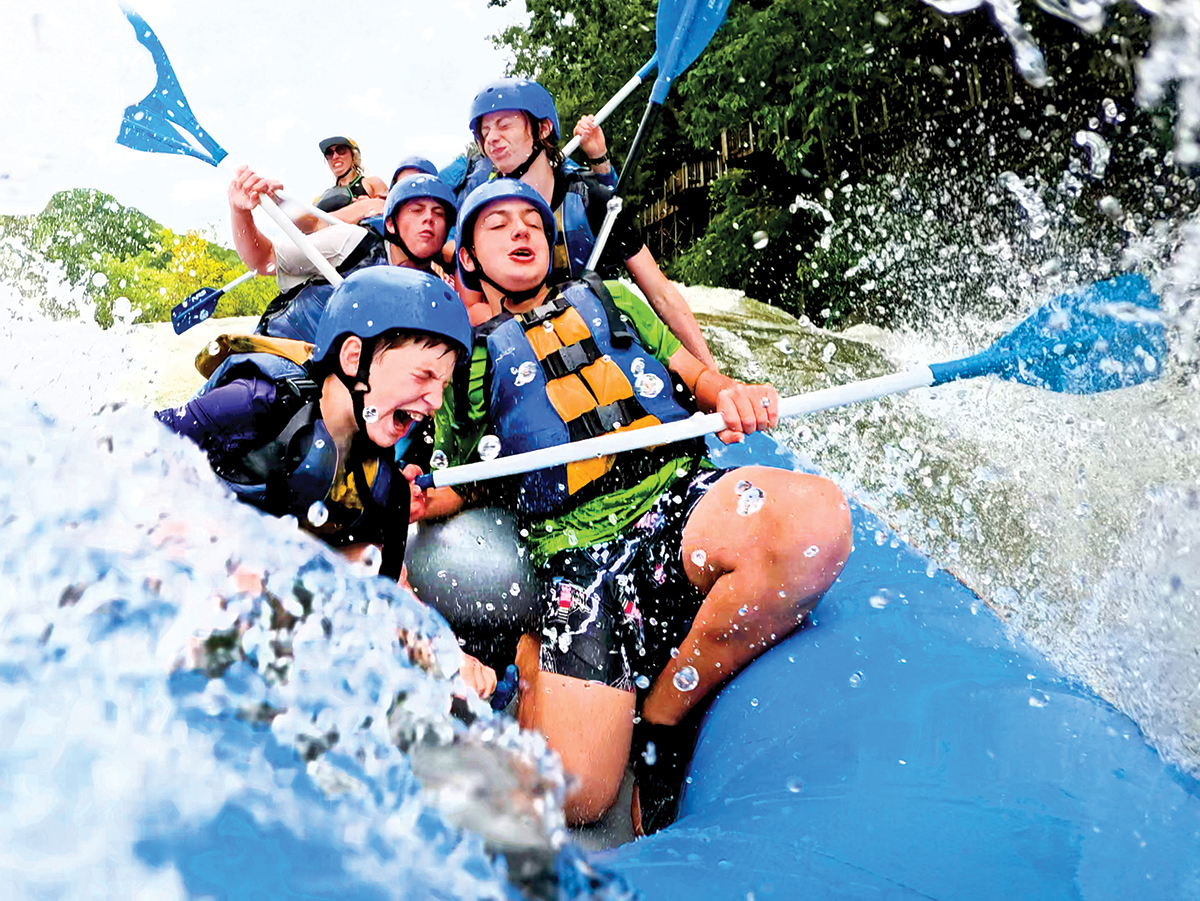
A menacing beast loomed before the Scouts of Troop 343. It was giant. It was thunderous. It dared the guys to confront it, as it left a frothy trail of chaos in its wake.
It was Godzilla!
And it was a whole lot of fun.
Cameron Alford, Luke Ratliff, Logan Self and Jackson Beene splash through a rapid.
" data-large-file="https://i0.wp.com/scoutlife.org/wp-content/uploads/2026/05/whitewater-7.jpg?fit=700%2C526&ssl=1" alt="" width="700" height="526" class="aligncenter size-full wp-image-190802" srcset="https://i0.wp.com/scoutlife.org/wp-content/uploads/2026/05/whitewater-7.jpg?w=1200&ssl=1 1200w, https://i0.wp.com/scoutlife.org/wp-content/uploads/2026/05/whitewater-7.jpg?resize=300%2C225&ssl=1 300w, https://i0.wp.com/scoutlife.org/wp-content/uploads/2026/05/whitewater-7.jpg?resize=150%2C113&ssl=1 150w, https://i0.wp.com/scoutlife.org/wp-content/uploads/2026/05/whitewater-7.jpg?resize=768%2C577&ssl=1 768w, https://i0.wp.com/scoutlife.org/wp-content/uploads/2026/05/whitewater-7.jpg?resize=174%2C131&ssl=1 174w, https://i0.wp.com/scoutlife.org/wp-content/uploads/2026/05/whitewater-7.jpg?resize=70%2C53&ssl=1 70w" sizes="(max-width: 700px) 100vw, 700px"/>
“Godzilla” is a powerful whitewater rapid along the Ocoee River in Tennessee, nicknamed for its sheer size and strength. Troop 343 of Huntsville, Alabama, faced Godzilla along with other churning challenges during an 8-mile whitewater float trip last summer.
“We went down the first part, which was Class III rapids. Those aren’t so bad,” says Jack Kelley, 14, a First Class Scout. “You look up ahead and you see Godzilla, and it’s a wall of water.”
And Godzilla wasn’t the only monster rapid the Scouts encountered.
Left: A raft dips into a hole. Top right: Jack Delduco, Raaen Stewart, Kyle Grosnick, Conner Stewart, Zain Butt and Greg Stahl steer through the waves. Bottom right: Logan Self and Jackson Beene emerge from riding a wave with their crew.
Working with a rafting outfitter, the Scouts loaded into inflatable boats and steered their way down the river with the help of expert guides at the helm. The trip lasted about five hours as the group navigated through Class III and Class IV rapids. (Older Scouts who are classified swimmers can go through rapids up to Class IV with a professionally trained guide.)
“Whitewater rafting is fun and scary,” says Daniel Acosta, 14, a Life Scout. “It builds relationships with the people around you.”
Some Scouts had gone rafting before, but the whole troop reviewed Scouting America’s Safety Afloat guidelines so everyone could be safe on the water.
“I think it’s important that all Scouts try new things,” says Life Scout Jack Delduco, 16. “Even if you’re scared, that’s bravery. A Scout is brave.”
Left: The group reviews safety protocols and signals before getting on the water. Right: Kyle Grosnick checks the fit of Jack Delduco’s life jacket, pulling up on the straps to make sure the jacket fits snugly.
The outfitter guides went over the rules and commands beforehand. They know the river and teach how to approach certain obstacles, including what to do if the boat capsizes or you accidentally fall out.
“If you were to fly out of the boat, they’d throw you a rope and reel you in,” Jack Delduco says. “And if you were to get into a hydraulic, they tell you what position to get in to pop out of those.”
Top: Jack Delduco loads into the raft. Bottom: The group loads into the rafts near one of the dams on the river.
A hydraulic, or hole, forms when water flows over a large rock and begins circulating, which can trap you. It’s one of many whitewater features to be familiar with before a trip.
The Scouts encountered about 20 rapids, but it wasn’t a rough ride the whole time.
“It’s like a light switch,” Daniel says. “It’s super intense, and then it’s calm water. It’s based on how the rocks form.”
Left: Scouts with Troop 343 tackle the Powerhouse Rapid with help from a professional guide. Right: Scouts navigate the rapids with their professionally trained guide, a must for Class IV rapids.
Some obstacles that whitewater rafters can conquer on the Ocoee were placed for canoe and kayak slalom events at the 1996 Summer Olympic Games. But before the Scouts tackled the Olympic section of the river, they pulled over to get instruction from their guides. Then each raft went one at a time.
First, they rolled over a few Class III rapids before heading toward the huge Class IVs, like “Godzilla” and “Humongous.”
“Godzilla is a big hydraulic, and Humongous is even bigger,” says Life Scout Luke Ratliff, 13.
Cameron Alford, Luke Ratliff, Logan Self and Jackson Beene splash through a rapid.
The guide in each raft shouted orders, directing the guys when to paddle so the boat hit the turbulent water just right. And it worked — most of the time.
“We’d all lean forward, and the water would pour in,” Daniel says. “Our friend Reid just flew out somehow. As he fell out, he hugged another kid, and they both dove into the water. We pulled them back in.”
Waterlogged and exhausted, the guys felt accomplished making it through the Olympic section.
“Everyone was glad they did it,” Jack Delduco says. “You have to work hard. It’s physical; you’re rowing the whole time. Teamwork goes into it.”
Jack Delduco paddles through the Olympic section of the river.
When you take on a challenge with a group, you discover not only your strengths and weaknesses but also those of others. To succeed, the group must play to everyone’s strengths. Getting through it together is the ultimate goal.
“Doing stuff like this allows me to know my troop better,” says Life Scout Logan Self, 14. “This was my first whitewater experience, and it was pretty fun. I plan to do it again.”
Luke Ratliff and Jackson Beene celebrate getting through the whitewater on the Ocoee River, which is known for its Class III and Class IV rapids. The more intense the rapids, the higher classification they’re given.
A key piece of whitewater rescue equipment is a throw bag, a coiled rope stored within a nylon bag you can toss to someone who’s fallen out of the raft. Practice using one before your whitewater journey. Here’s how:
• Remove enough rope from the bag so you can hold one end of the rope when you throw the bag.
• Toss the bag just beyond the swimmer’s head so they can grab the rope.
• Tell the swimmer to firmly grasp the rope with both hands; they should not tie it around their arm or neck.
• Pull the person back to safety, being careful not to tangle the rope or fall in yourself.
JL VETERAN 37 MALANG


