

The Electronics merit badge is a great way for Scouts to learn about how electronic devices work. Electronics are all around us, from smartphones and computers to home appliances and cars. This badge helps Scouts explore the basics of electronics and how they are used in everyday life. It’s a fun way to discover how science and technology connect to the world we live in.
While working on the Electronics merit badge, Scouts will learn how to build and test simple electronic circuits. They will get hands-on experience with tools and materials used by engineers and hobbyists. This helps them develop problem-solving skills as they figure out how to make things work. They will also gain confidence by completing projects that show how electronics can be creative and practical.
The Electronics merit badge also encourages Scouts to think about future careers. Electronics is a field with many opportunities, from designing new gadgets to fixing and maintaining important systems. By exploring this subject, Scouts might discover a new hobby or even consider a job in science, engineering, or technology. It can open up new possibilities for their future.
Scouts who earn the Electronics merit badge also learn valuable skills like patience and attention to detail. These skills are important in many parts of life, not just in electronics. The badge challenges them to think critically and work carefully, which helps them grow as individuals. It’s a rewarding experience that gives Scouts practical knowledge they can use in real life.
The requirements for this merit badge were updated effective January 1, 2025.
Find specific helps for some of the merit badge requirements listed below. Some of these resources will just give the answers. Others will provide engaging ways for older Scouts to introduce these concepts to new Scouts.
Describe the safety precautions you must exercise when using, building, altering, or repairing electronic devices.
Safety is very important when working with electronic devices. Electricity can be dangerous if you don’t know what you’re doing. For the Electronics merit badge, you will need to understand and follow safety rules when using, building, changing, or fixing electronics. These rules help keep you and the people around you safe.
Here are some basic safety precautions to follow:
Terms like “short circuit” and “capacitor” might be new to you. A short circuit happens when electricity takes a shortcut through a path it’s not supposed to, causing heat and sometimes sparks or fires. A capacitor is a small part in an electronic device that stores and releases electrical energy. Both are important to know about when working with electronics.
By following these precautions, you can safely complete projects for the Electronics merit badge. Learning how to work with electronics safely will also give you the skills to tackle more advanced projects in the future. Safety is always the first step toward success.
Do the following:
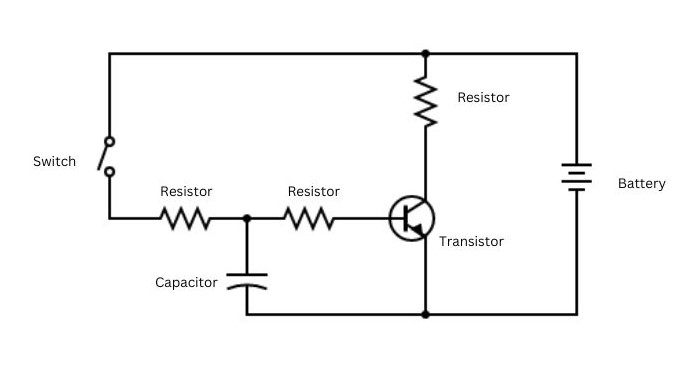
The diagram above is a basic electronic circuit. It shows common components like resistors, capacitors, and transistors. These are key parts you will learn about while earning the Electronics merit badge.
By studying diagrams like this, you can understand how circuits work and build your own projects for the Electronics merit badge. This knowledge will help you with more advanced electronics in the future.
Do the following:
Learning how to solder and desolder is an important skill for the Electronics merit badge. Soldering is the process of joining two metal parts using a melted metal alloy called solder. This creates a strong electrical connection. Desoldering is the reverse process, where you remove solder to disconnect components. Both skills are needed for building and repairing circuits.
Soldering and desoldering take practice, but they are useful skills for anyone interested in electronics. As you work on the Electronics merit badge, you will gain confidence in handling these tools safely and correctly. These skills will also help you repair or create more complex circuits in the future.
When working on the Electronics merit badge, you will use tools like soldering irons that generate heat. While soldering is necessary for building circuits, too much heat can damage sensitive electronic components. Understanding how to avoid heat damage will help you build better circuits and keep your parts working properly.
Electronic components, like transistors and capacitors, are designed to handle only a certain amount of heat. Excessive heat can melt parts, weaken connections, or change how the component works. For example, too much heat can burn a printed circuit board (PCB) or cause a capacitor to fail. Learning to manage heat is key to successful soldering and circuit building.
By following these tips, you can prevent heat damage while working on your Electronics merit badge projects. Protecting your components ensures your circuits work correctly and last longer. This is an important part of learning how to build and repair electronics safely.
Printed circuit boards (PCBs) are essential in almost all electronic devices. They serve as the foundation for building circuits, holding components like resistors, capacitors, and transistors in place. PCBs also connect these components using thin, conductive pathways, usually made of copper. When earning the Electronics merit badge, you’ll likely work with a PCB and learn how to solder components onto it.
PCBs make it easier to organize and connect electronic parts. Instead of using messy wires to link components, a PCB provides a clean and efficient layout. The board’s design ensures each component connects properly, allowing the circuit to function as intended. PCBs are used in everything from computers and phones to household appliances and toys.
When soldering components onto a PCB for your Electronics merit badge, you need to handle the board carefully to avoid damage. Follow these steps to keep your PCB and components in good condition:
By understanding the function of a PCB and following these precautions, you can safely and effectively solder for your Electronics merit badge projects. Taking care of your PCB ensures your circuit works properly and gives you a strong foundation for future electronics work.
Do the following:
Electronics are often used to control how devices and machines work. For example, electronics can turn lights on and off, adjust a fan’s speed, or move a robot’s motor. When working on the Electronics merit badge, you’ll explore how circuits and components can be combined to create systems that control actions automatically or with a switch.
Control circuits use input devices, processing units, and output devices to make something happen. Here’s how it works:
Understanding how to use electronics for control is a practical skill you will learn while earning the Electronics merit badge. You’ll see how simple components can combine to create systems that solve problems or make tasks easier. These skills will help you with future projects and open up creative possibilities in electronics.
Digital techniques are used in almost all modern electronics, from computers and smartphones to appliances and cars. Digital electronics work with signals that are either on or off. These two states are represented by the numbers 1 and 0, which are the foundation of digital systems. Learning the basic principles of digital techniques is an important part of earning the Electronics merit badge.
Digital electronics are reliable because they work with clear on/off signals, which makes them less sensitive to interference than analog systems. They can also store and process huge amounts of data very quickly. These features are why digital techniques are used in almost every modern device.
As you work on the Electronics merit badge, you will learn more about digital techniques and how they are used in circuits. Understanding these principles is key to building and troubleshooting modern electronic devices. These skills can also help you in school or with future technology-related projects.
Electronics are not just about computers and phones. They also control many systems in everyday life. For the Electronics merit badge, Scouts explore how electronics work and learn about real-world applications. One important part is understanding analog systems.
Here are three examples of analog applications you might use electronics for:
By exploring these examples, you can see how electronics make everyday tasks easier. Working on the Electronics merit badge helps you learn how to design and build these kinds of systems.
When working on the Electronics merit badge, you’ll learn how to work with binary numbers. Binary numbers are used in digital electronics because they represent information using only two states: 1 (on) and 0 (off). This system is called the binary system. In contrast, the decimal system (which we use in everyday math) uses ten digits: 0 through 9. Understanding how to convert between these two systems is an important skill for understanding digital electronics.
To convert a decimal number to binary, follow these steps:
Example: Convert 13 (decimal) to binary.
Write the remainders in reverse order: 1101. So, 13 in decimal is 1101 in binary.
To convert a binary number to decimal, follow these steps:
Example: Convert 1101 (binary) to decimal.
Add the results: 8 + 4 + 0 + 1 = 13. So, 1101 in binary is 13 in decimal.
Learning how to convert between decimal and binary is an essential part of understanding digital techniques for the Electronics merit badge. These conversions show how numbers are stored and processed in electronic devices like computers and calculators. Practice these steps, and you’ll be ready to handle binary numbers confidently!
For this Electronics merit badge requirement, you’ll build a circuit and explain how it works. Below are examples of three types of projects: a control device, a digital circuit, and an analog circuit. Each example includes a brief explanation of the schematic and how the circuit functions. Choose the one that interests you most!
Example: A light-activated circuit using a photoresistor.
Example: A circuit with an AND gate.
Example: An amplifier circuit for a small speaker.
Once you build your circuit, use its schematic diagram to show how the components are connected. Explain each component’s role and how they work together to make the circuit function. For example, in the light-controlled switch, describe how the photoresistor and transistor interact to turn the LED on and off.
Building and explaining a circuit for the Electronics merit badge helps you understand how electronic devices work in real life. It also gives you hands-on experience with tools and components, preparing you for more advanced projects in the future!
Do the following:
Ohm’s Law is a basic rule in electronics that explains the relationship between current, voltage, and resistance in a circuit. It’s a key concept for the Electronics merit badge because it helps you understand how electricity flows through a circuit. The formula is:
V = I × R
Where:
Question: A circuit has a 12-volt battery and a resistor with a resistance of 6 ohms. What is the current flowing through the circuit?
Answer: The current flowing through the circuit is 2 amperes (A).
Ohm’s Law helps you figure out the right components for a circuit. For example, if you’re designing a circuit for the Electronics merit badge and know the voltage and desired current, you can calculate the resistance needed. Similarly, you can check if your circuit is working correctly by measuring voltage, current, or resistance and using the formula to verify the values.
By practicing problems like this, you’ll gain a better understanding of how electricity behaves and how to control it in circuits. This is an important skill for building and troubleshooting electronic projects.
When working on electronic circuits, test equipment is essential for troubleshooting, measuring, and ensuring everything is working correctly. Test equipment helps you find problems in your circuits, check your work, and make adjustments if needed. While earning the Electronics merit badge, you’ll learn about different tools used to test electronic devices and circuits.
Test equipment allows you to measure things like voltage, current, and resistance to see how your circuit is performing. If a circuit isn’t working, test equipment helps you figure out what’s wrong—whether it’s a broken connection, a bad component, or something else. This ensures that your projects are safe, reliable, and functional.
Multimeter:
Oscilloscope:
Continuity Tester:
Logic Probe:
Signal Generator:
By using test equipment, you can build better and more reliable circuits for the Electronics merit badge. These tools give you confidence that your work is accurate and help you troubleshoot when things don’t go as planned. Learning how to use test equipment is an important step toward mastering electronics!
Resistors are essential components in electronics, and they are used to control the flow of current in a circuit. Each resistor has a specific resistance value, measured in ohms (Ω). For the Electronics merit badge, you need to know how to read the colored bands on a resistor to determine its resistance value. These color bands are a code that tells you the resistance without needing to test the resistor.
A typical resistor has four color bands. Each band represents a number or multiplier, and the last band shows the tolerance (how accurate the value is). Here’s what the bands mean:
| Color | Number | Multiplier | Tolerance |
|---|---|---|---|
| Black | 0 | ×1 | |
| Brown | 1 | ×10 | ±1% |
| Red | 2 | ×100 | ±2% |
| Orange | 3 | ×1,000 | |
| Yellow | 4 | ×10,000 | |
| Green | 5 | ×100,000 | ±0.5% |
| Blue | 6 | ×1,000,000 | ±0.25% |
| Violet | 7 | ×10,000,000 | ±0.1% |
| Gray | 8 | ±0.05% | |
| White | 9 | ||
| Gold | ×0.1 | ±5% | |
| Silver | ×0.01 | ±10% |
Question: A resistor has these color bands: Brown, Black, Red, and Gold. What is its resistance?
Answer: The resistor has a value of 1,000 ohms (1 kΩ) with a tolerance of ±5%.
By learning to read resistor color bands, you can quickly identify the resistance values of components in your Electronics merit badge projects. This skill is essential for building and troubleshooting circuits with the correct components. Practice reading resistors to get more confident!
When building electronic devices, the parts need to be attached to a circuit board. Two common ways to do this are Through Hole and Surface Mount assembly technologies. Learning the differences between these methods is an important step for the Electronics merit badge.
Through Hole assembly involves inserting electronic components into holes drilled in the circuit board. The parts are then soldered to keep them in place. This method has been used for a long time and is still useful in some applications.
Advantages of Through Hole Technology:
Surface Mount assembly places components directly on the surface of the circuit board. The parts are much smaller and are attached using a solder paste.
Advantages of Surface Mount Technology:
Knowing these technologies will help you understand how electronics are made. For the Electronics merit badge, you’ll explore these methods and gain hands-on experience with electronic components.
Identify three career opportunities that would use skills and knowledge in Electronics. Pick one and research the training, education, certification requirements, experience, and expenses associated with entering the eld. Research the prospects for employment, starting salary, advancement opportunities and career goals associated with this career. Discuss what you learned with your counselor and whether you might be interested in this career.
Electronics is a field with many career paths, offering opportunities in design, repair, and innovation. While earning the Electronics merit badge, you can explore various roles to see what interests you. Below are some careers which you might explore further.
Exploring these careers during the Electronics merit badge can help you understand the variety of opportunities in this field and find a path that matches your interests. Each role uses skills in electronics to solve problems and create innovative solutions.
The Engineering program feature helps Scouts learn how to solve problems and design solutions for real-world challenges. Troop meetings focus on hands-on activities like building water filters, designing Rube Goldberg machines, or making LED flashlights. Scouts explore different fields of engineering, such as civil, chemical, and electrical, while experimenting with materials and learning about systems like bridges and rockets. These activities show how engineering improves our daily lives.
Scouts working on the Engineering program can also explore connections to the Electronics merit badge by building and testing circuits or diagnosing problems in broken devices. The Electronics merit badge and engineering projects encourage creativity, teamwork, and critical thinking, preparing Scouts for future careers or hobbies in technology.

Merit badges let Scouts explore topics like sports, science, trades, and future careers. With over 100 merit badges to choose from, there’s something for everyone. You don’t need to wait for rank advancement—any Scout can start earning merit badges at any time. Whether you’re interested in outdoor skills, fine arts, or information technology, merit badges help you learn new things and develop useful skills.
The Electronics merit badge is a great way to dive into science and technology. It teaches practical skills like building circuits and understanding how electronics work. By earning the Electronics merit badge, Scouts can discover new interests and explore possible careers in technology.

Scouts BSA is a program for youth aged 11 to 17 that helps them grow through adventure, leadership, and service. Scouts participate in outdoor activities like camping and hiking, while learning important skills and values from the Scout Oath and Law. The patrol system encourages teamwork and leadership, and Scouts work together to plan activities and make decisions.
Merit badges are a key part of Scouts BSA, offering a chance to explore new interests like the Electronics merit badge. This badge introduces Scouts to the exciting world of circuits and technology. By earning the Electronics merit badge, Scouts gain practical skills and build confidence for future challenges.
What do I need to know before starting the Electronics merit badge?
You don’t need to have advanced knowledge of electronics to start. It’s helpful to understand basic science and how electricity works, but the merit badge will teach you everything step by step.
What will I learn by earning the Electronics merit badge?
You’ll learn how electronic circuits work, how to build and test simple circuits, and how to use tools like soldering irons and multimeters. You’ll also explore how electronics are used in everyday life.
Do I need to buy expensive tools for the Electronics merit badge?
No, you don’t need to buy expensive tools. Your counselor will often provide the equipment you need, like a soldering iron or multimeter. You may need to buy small items like resistors or wires, but they are usually inexpensive.
Is the Electronics merit badge hard?
The difficulty depends on your interest and experience. If you are curious and willing to learn, the steps are clear and manageable. You’ll have fun building and testing circuits!
What kind of projects will I build for the Electronics merit badge?
You’ll build simple circuits, such as a control circuit, digital circuit, or analog circuit. Each project will help you understand how components like resistors, capacitors, and transistors work together.
Do I need to know math to earn the Electronics merit badge?
You will use basic math when working with Ohm’s Law (voltage, current, and resistance). Don’t worry—your counselor will guide you through it.
Can I work on the Electronics merit badge by myself?
Some parts, like learning concepts and building circuits, can be done alone. However, you’ll need a counselor to guide you, answer questions, and approve your work.
What safety rules should I follow for the Electronics merit badge?
Safety is very important in electronics. Always turn off power before working on a circuit, avoid water near electronics, and use tools correctly. Your counselor will teach you more about safety during the badge.
How does the Electronics merit badge prepare me for a career?
You’ll gain hands-on experience and learn skills used in many electronics careers, like troubleshooting circuits and working with tools. This badge can inspire you to explore jobs in engineering, robotics, or technology.
Do I need to complete a written report or test for the Electronics merit badge?
No, the Electronics merit badge focuses on practical skills. You’ll complete projects, explain how circuits work, and demonstrate your knowledge to your counselor.
The Electronics merit badge is your chance to explore the amazing world of electronics. Electronics are everywhere, from your smartphone to your TV, and even in cars and appliances. This badge teaches you how circuits work and helps you understand how these everyday devices are built. By working on this badge, you’ll learn to build, test, and troubleshoot your own circuits.
During the Electronics merit badge, you’ll work with components like resistors, capacitors, and transistors. You’ll use tools like soldering irons and multimeters to complete hands-on projects. You’ll also learn about safety, so you can handle electricity and tools without risk. The badge is a mix of fun projects and useful lessons, helping you develop new skills.
This merit badge also introduces you to careers in electronics. You’ll see how engineers, technicians, and designers use electronics to solve problems and create new technologies. Whether you’re interested in computers, robotics, or analog equipment, this badge shows you how it all starts with circuits. It’s a great way to discover new interests and prepare for the future.
The Electronics merit badge is perfect for Scouts who like to build things, solve problems, and explore technology. It’s a fun and rewarding experience that can inspire new hobbies and even career goals.
JL VETERAN 37 MALANG